
Welcome to our space for industry insight — what we're seeing, hearing, and thinking.
We spend our days in conversation with market leaders, designers, and creatives across London's design scene. It gives us a real-time, front-row view of what's actually shaping the industry.
Hiring trends, salary shifts, career guidance, and the chatter that doesn't always make it into the headlines — we unpack it all here.
Grab a cuppa and explore.
We asked, you answered: how the creative industry really feels about AI
Over half of the people we asked use AI every day. What surprised us wasn't how many. It was what they're worried about.
Over the past month, we put a few simple questions to our LinkedIn community about AI at work. Nothing complicated. Just an honest look at how people are actually using it, and how they feel about it.
The answers weren't surprising. But they were telling.
Nearly everyone's using it, and most think it helps
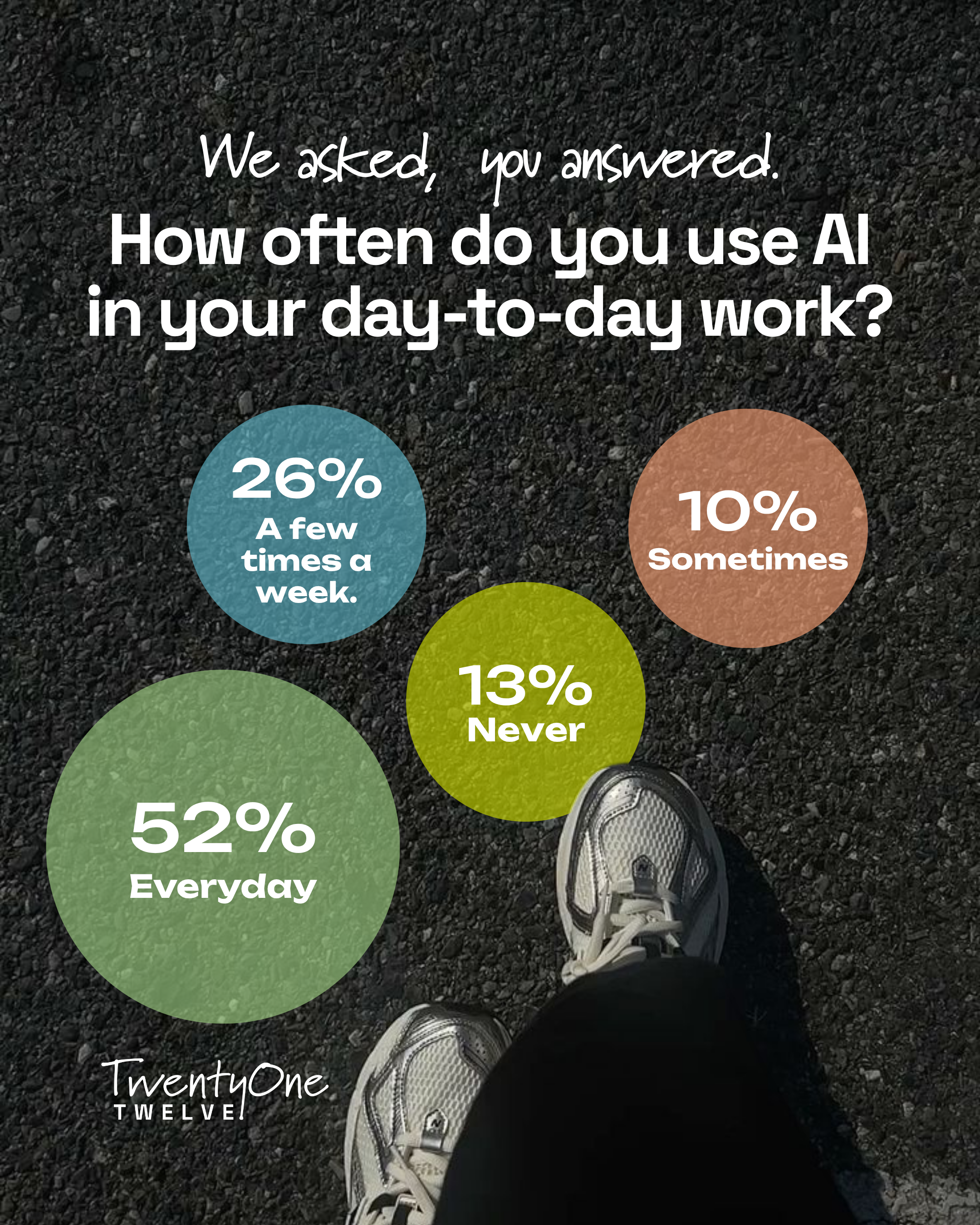
More than half of people said they use AI every day (52%), and another quarter reach for it a few times a week. Only a small handful said they never touch it.
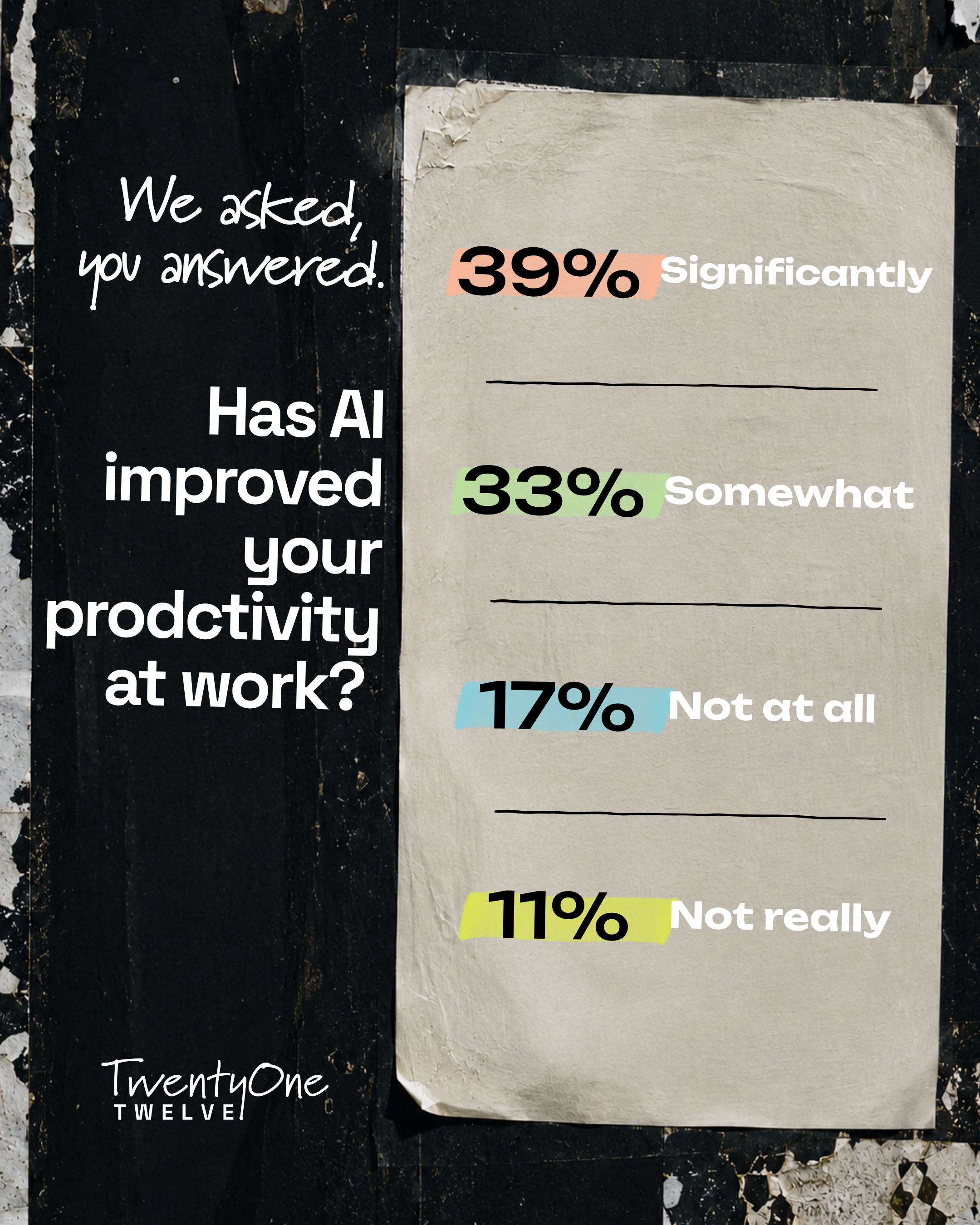
When we asked whether AI had improved their productivity, almost three quarters said yes. Thirty-three percent said significantly, thirty-nine percent said somewhat. In the space of a couple of years, AI has quietly become another tool in the working day, sitting alongside the inbox and the calendar.
So far, so expected.
What people are worried about has changed
The most interesting answer wasn't about how much people use AI. It was about what's on their mind when they do.
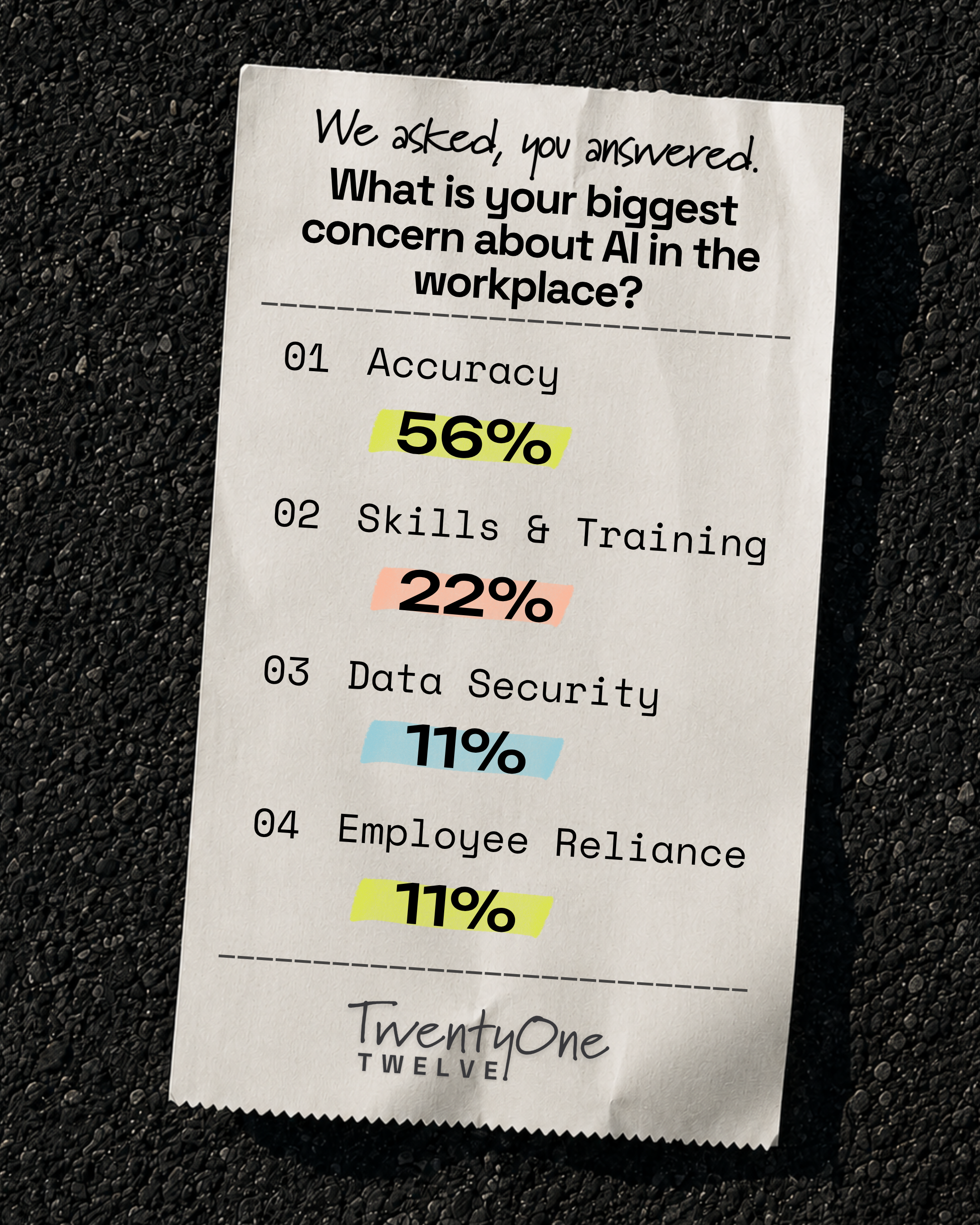
When we asked about their biggest concern, accuracy came out on top by a distance. Fifty-six percent named it, well ahead of skills and training (22%), data security (11%), and over-reliance (11%).
To me, that says something bigger about where the conversation has landed.
A year ago, the question was whether AI would take people's jobs. Now it's whether we can trust what it gives us. That's a healthier place to be. It means people have stopped treating AI as a threat and started treating it as a tool, one that needs checking, judgement, and a person keeping an eye on it.
We're seeing the same shift in recruitment
Very few clients come to us asking for "AI experts". What they actually want is people who can use AI to work smarter, while still bringing creativity, critical thinking, and sound judgement to the table.
The tool is easy to learn. Knowing when to trust it, and when to push back, is the harder and more valuable skill.
Most businesses are still finding their feet
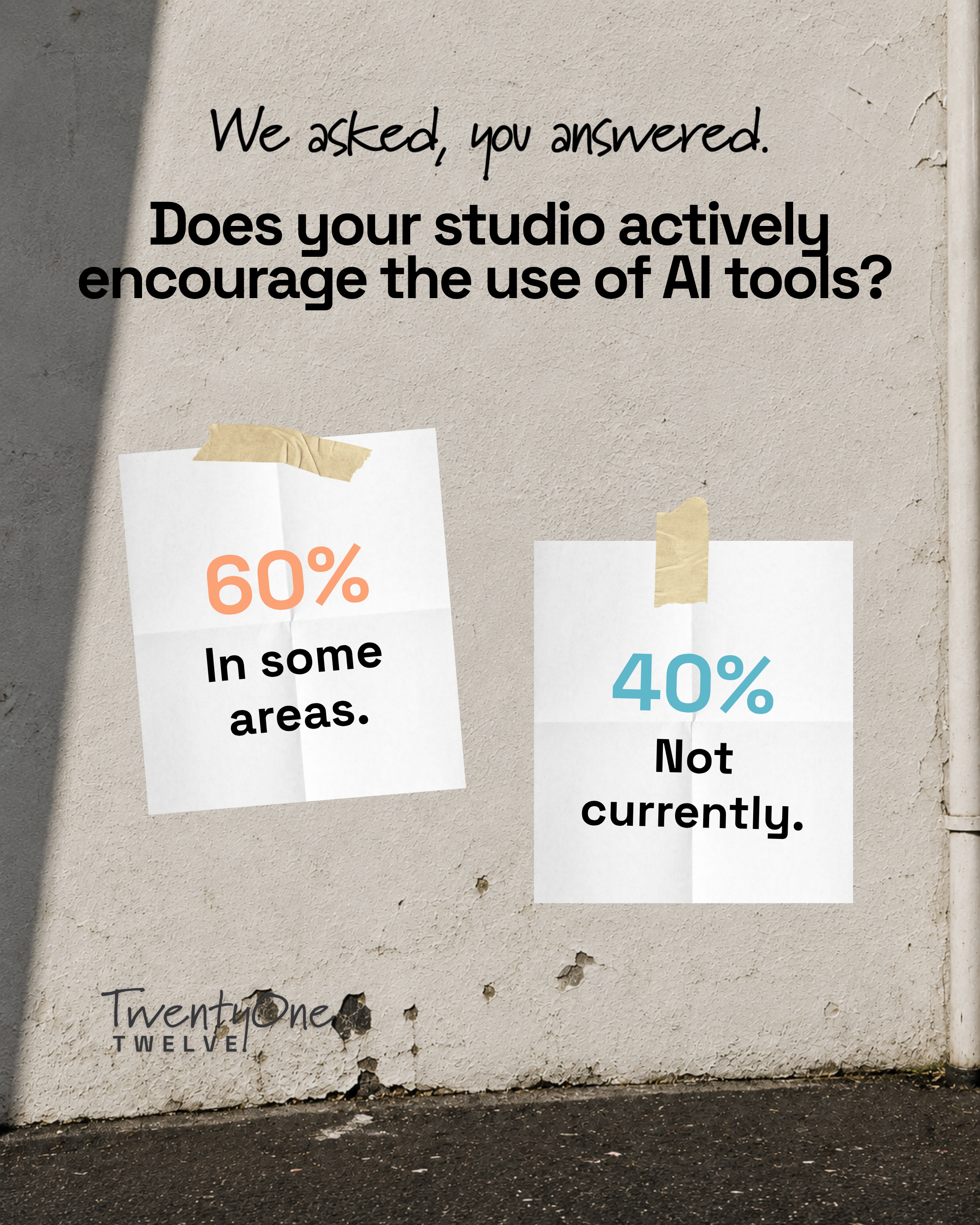
One answer summed up the moment nicely. Sixty percent of people said their organisation encourages AI in some areas, but not a single person said it was fully embedded across the business.
That feels about right. Most companies can see the opportunity. They're still working out how to take it responsibly, without cutting corners on quality or trust.
For me, that's exactly where the opportunity sits.
The people who'll stand out aren't the ones using AI the most
They'll be the ones who know when to use it, when to leave it alone, and how to pair it with the things technology still can't do.
AI can make you faster. But curiosity, empathy, original thinking, and strong relationships are still what make the real difference. I don't see those becoming less valuable. If anything, they're becoming the whole point.
Hybrid Working Isn't Broken. Your Model Is.
Flexibility still matters, but the studios winning on talent are the ones who know how to use it with intention.
Flexible working isn't new. We've all lived through it for years now. But the conversation has matured. Studios that haven't kept up are losing people unnecessarily.
In 2020 and beyond, candidates held all the cards. Flexibility wasn't just expected. It was demanded. Studios scrambled to offer it or risk losing talent.
Now? The market has settled. Employers have more choice. Return-to-office mandates are everywhere. Amazon, Disney, major studios calling people back four or five days a week.
So is hybrid dead?
Not quite.
But the question isn't whether you offer it anymore. It's whether you know how to make it work.
Because the studios getting this right are building stronger teams, keeping talent longer, and developing juniors faster. The ones getting it wrong are hiring people who leave within a year, wondering why their culture feels flat.
What people actually want.
We ran a poll recently. Asked creative professionals if they'd do a four-day week. 73% said absolutely.
Another poll asked which work environment brings out their best creative work. 67% said hybrid.
The appetite for flexibility is real. But wanting something and knowing how to use it well are different things.
The studios still winning on talent aren't offering unlimited work-from-home. They're not forcing everyone back full-time either.
They've figured out a model that delivers results for everyone.
Team days aren't optional.
Pick your days. Tuesday to Thursday usually work best. Get everyone in. Make them count.
The 67% who voted for hybrid aren't asking to never see their colleagues. They're asking for focused time at home and collaborative time together. Give them both, with intention.
Here's what success looks like: A team that knows Wednesday is the day everyone's in. That's when you book the big crit. The brainstorm. The conversation that needs energy. People come in because it's worth it, not because they have to. Chemistry builds. Ideas move faster. Problems get solved in real time instead of over three days of Slack threads.
Here's what failure looks like: A team that drifts in randomly. Sits on video calls in separate rooms. Wonders why the work feels disconnected. You hired talented people and accidentally isolated them.
Studio time is career fuel, especially for juniors.
Here's the uncomfortable truth.
Hybrid used to be a perk earned with experience. Seniors had already clocked years learning from people around them. They'd built their networks. Absorbed how studios work. Developed their instincts.
Juniors asking for three days at home from day one are unknowingly stunting their own growth.
You learn faster sitting next to someone solving a problem than unpicking a Slack thread. You build your reputation in the studio, not on a screen. You pick up the unspoken stuff by being there when it happens. How to handle a tricky client. When to push back. How to sell an idea.
This isn't about control. It's about opportunity.
Juniors who spend most of their week at home often find themselves stuck at junior longer. They're not in the room when decisions are made. They're not grabbing coffee with the senior designer who could mentor them. They miss the moment when someone says, "Actually, can you help with this pitch?"
Studios that figured this out have juniors who progress faster, stay longer, and become the mid-level talent they're desperate to hire externally.
Studios that didn't are hiring juniors who leave after 18 months because they never felt part of the team.
If you're hiring juniors, be honest about this. Four days in the studio for the first year or two isn't punishment. It's investment. In them. In your studio.
Be clear about what works for you.
Vague promises of "flexibility" help no one.
If you need people in four days a week to make the work sing, say it. If two days works, own it. Candidates respect clarity far more than being sold one thing in the interview and experiencing another three months in.
Figure out your model. Discuss it with your leadership team.
What are your non-negotiables? Does everyone need to be in on set days, or can people choose? Are there specific hours you need coverage? What would you flex on for the right person?
Then talk about it positively.
Don't say, "We do three days in the studio, but honestly we do our best work when everyone's here." You've just told a candidate you don't believe in your own model.
Sell what works for your studio. If three days is your sweet spot, explain why. If it's four, same.
Studios that get clear on this hire people who want to work that way. Studios that stay vague hire people who feel misled and start looking three months in.
Flexibility done right is still a competitive advantage.
The market has stabilised. Employers have more leverage than they did a few years ago.
But the studios still attracting the best people in 2025 aren't the ones forcing everyone back out of principle. Or offering endless WFH because they're scared to ask for commitment.
They're the ones who've built sustainable hybrid models.
Geography still matters less than it used to. A talented designer in Manchester or Berlin is more accessible now than they were five years ago. Freelancers can plug in from anywhere, as long as they're set up for UK projects and available when you need them. That broader talent pool hasn't gone away.
But for permanent hires, especially juniors and mid-levels, studio time isn't negotiable.
Creativity is collaborative. Careers are built through proximity. The best work happens when people are in the same room, bouncing off each other, building something together.
Hybrid working is here to stay. But only the version that actually works.
Clear team days. Honest expectations. Studio time weighted towards juniors who need it most. And a recognition that flexibility is a tool, not a right. It only delivers results when everyone understands how to use it.
Figure out your model. Commit to it. Then hire people who want to work that way.
You'll build a stronger team. Keep them longer. And stop losing talent to studios who worked this out two years ago.
Our 2025 Salary Report Is Here.
Our 2025 Salary and Sentiment Report is live. Creative roles are back in demand, salaries have lifted across the board, and flexibility has become non-negotiable. Here's what's changed since 2024.
A first look at what's changed from 2024 to 2025.
The TwentyOne Twelve 2025 Salary and Sentiment Report is now live. Every year, we speak to studios and candidates across the UK to find out what's actually happening in the design industry. Not assumptions. Not projections. Real conversations about pay, priorities, and what people want from work.
This year's findings show some clear shifts. Here's what's changed since 2024.
Creatives Are Back in Demand
Last year, studios leaned heavily on technical and delivery roles. In 2025, that's flipped. Creative briefs are back, with renewed investment in brand, storytelling, and strategy. Studios that paused creative hiring in 2024 are building teams again, and competition for strong conceptual talent is rising.
Permanent Roles Are Becoming the Safer Bet
Freelancer day rates keep climbing, but client fees haven't followed. That gap is pushing studios to rely more on permanent hires to keep teams steady and margins healthy. It's a sharper version of what we saw in 2024, with studios now balancing freelance and permanent talent far more intentionally.
Salaries Have Lifted Across Almost Every Discipline
The rise in the National Minimum Wage has pushed up graduate and junior salaries, and that ripple has carried through to midweight and senior levels. We're seeing clear increases across interiors, branding, digital, strategy, and client services.
The full report breaks down every salary band, role, and day rate so studios can benchmark with accuracy.
Flexibility Is Now Non-Negotiable
Hybrid working has shifted from a preference to a dealbreaker. Even with great projects on the table, candidates are turning down roles that don't offer flexibility. Salary and hybrid now stand as the top two motivators when people consider a move.
A More Positive Market Outlook
There are still challenges around junior and very senior roles, but overall sentiment is more optimistic than it was a year ago. Respondents noted more flexibility across studios, stronger sustainable practices, and a healthy return of the creative work that dipped in previous years.
If you'd like the full breakdown, including salary tables, day rates, and market sentiment from designers and studios across the UK, get your copy here.
Creative Industry Trends 2025: What's Shaping London's Design Market.
The UK's creative sector has grown 9% since 2020, far outpacing the broader economy. London hosts nearly 30% of design jobs, and demand for creative talent is only accelerating. Here's what's shaping the industry in 2025 and what it means for your career or your next hire.
The UK’s creative industry is booming, driven by exciting digital innovations and a surge in demand. From virtual reality to AI-powered design, companies are looking for skilled creative talent to lead the way and deliver standout work that captures the imagination of clients and consumers.
Since February 2020, the UK’s creative sector has grown by an impressive 9% - far outpacing the broader economy’s 1.6% growth. It's an incredibly exciting time to ride this creative wave, whether you're a creative professional, a business owner, or a specialist in design recruitment!
Let’s dive into some key stats and trends that highlight where the buzz is strongest and what it means for jobs.
Rising Demand for Creative Professionals
The UK’s design economy is booming, and nowhere is this growth more evident than in London. From Architecture and Interior Design to Graphic and Digital Design, the demand for creative professionals is soaring. Between 2010 and 2019, the design economy grew at twice the rate of the UK economy, and all signs point to this momentum accelerating in 2025.
Our 2024 Market Review and Salary Report highlights rising hiring and salary trends across key fields like Interior Design, Digital Design, Architecture, and Client Services. London, the epicentre of the UK’s design economy, hosts nearly 30% of design jobs and a third of all design businesses. As Deloitte forecasts 4.3 million creative jobs by 2030, there’s no better time to be part of this vibrant and rapidly expanding sector. If you’re looking for opportunities in design, London is calling!
Growing Competition for Creative Talent
When you’re looking to hire someone for a design, digital or creative strategy role, you’re likely to find competition for good talent is rather tough. And the fact is, it’s not going to get easier in 2025. Whilst there is strong revenue growth evident for creative economy businesses, profitability is getting squeezed by increases in salaries and pay rates, as companies race to snap up skilled talent.
The challenge for employers is to demonstrate why their business is a great place to work – by articulating their employee value proposition (EVP). Companies with strong EVPs will cover the essentials of attracting talent, like a competitive base salary. But it’s just as important to emphasise other factors that make your company an attractive place to work. Flexible work arrangements, for example, have become increasingly valued by candidates in recent years – and we see no sign of that desire abating!
Creative professionals are also flocking to roles that offer autonomy and opportunities to work on inspiring projects and innovations. The most sought-after candidates want to work for companies that provide genuine career development and invest in their people for mutual growth. With that said, as an employer, you can differentiate by offering clear career growth paths and support for upskilling.
Investing in training and development may become increasingly essential rather than optional for employers in the creative industries, as there are warning signs of a dwindling pool of fresh graduate talent. The number of students taking Design and Technology (D&T) at GCSE has halved over the last decade, indicating that fewer young people are gaining foundational skills in creative disciplines.
AI Everywhere?
Generative artificial intelligence is by far the biggest headline story in several industries, particularly creative fields like design and digital. From graphic design, and 2D design to video and coding, AI has upped the ante for creative work. Now, the challenge is to see who can do the most interesting stuff with it!
Can we expect AI to replace many design jobs? Whilst it’s too early to make that call, we’ve seen numerous examples of gen AI lifting productivity for designers in multiple disciplines. Considering that the rate of AI adoption has at least doubled over the past five years, demand for designers shows no signs of slowing down.
In 2025, we could expect human skills and talent to come at an even higher premium, as AI use becomes increasingly mainstream. Professionals with a strong grounding in design disciplines will be highly sought after for their ability to combine creativity with strategic thinking.
Sensory Experiences
In 2025, we may firmly find ourselves in the realm of the senses, at least when it comes to design innovations. More interior design and architecture projects will involve creating multi-sensory spaces that blend digital and physical experiences. As Dentsu highlights, there’s a growing demand for immersive sensory activations, where elements like touch, sound, light, scent, and gesture converge to captivate audiences.
Engaging senses all five senses requires design and creative professionals with a multi-disciplinary mindset, who can meld the digital with the experiential.
Industries such as hospitality, retail, and cultural institutions are hunting for new ways to engage consumers with a multi-sensorial feast of sound, colour, light, touch and scent. From hotels incorporating haptic feedback into guest rooms to museums designing exhibits with interactive light and sound, the emphasis is on creating environments that stimulate and inspire – and look amazing on social !
Nostalgia Vibes
From the aesthetics of nostalgia (90’s fashion revival, music on vinyl, vintage cameras) to the growing desire to disconnect from digital technologies (at least once in a while), nostalgia will be a powerful force for creative professionals and consumers alike in 2025.
For built environment professionals (interior designers, architects), nostalgia will inspire the creation of spaces that evoke the vibes and memories of a bygone era – whether it be brutalism or mid-century modernism.
On the digital front, graphic designers will draw on forgotten visuals like the pixelated, DIY look of early MySpace pages or the grainy, low-res charm of flip phone photography. By remixing these tiny slices of history, brands can be sure to capture attention with a playful feel.
The Rising Tide for Creative Recruiters
With creative sectors set for a bumper year in 2025, people with a background in recruitment for creative sectors are going to see their boats lifted by the same tide.
As the creative sectors continue to expand, recruiters with experience in or passion for these industries will be instrumental. After all, creative businesses need help in identifying the talent that brings these trends to life. If that sounds like your kind of thing, we’d love to chat with you about our internal opportunities. Please feel free to send us a message to introduce yourself and pop your CV over to us!
Connect with the Creative Recruitment Specialists
Ready to add a team member or two, or planning your next career move for 2025? Twenty One Twelve’s creative and design recruitment specialists can help you get sorted with a solution or role that’s right for you.
Contact us today for support in growing your team or finding your next role. We’d love to chat with you!