
Welcome to our space for industry insight — what we're seeing, hearing, and thinking.
We spend our days in conversation with market leaders, designers, and creatives across London's design scene. It gives us a real-time, front-row view of what's actually shaping the industry.
Hiring trends, salary shifts, career guidance, and the chatter that doesn't always make it into the headlines — we unpack it all here.
Grab a cuppa and explore.
We asked, you answered: how the creative industry really feels about AI
Over half of the people we asked use AI every day. What surprised us wasn't how many. It was what they're worried about.
Over the past month, we put a few simple questions to our LinkedIn community about AI at work. Nothing complicated. Just an honest look at how people are actually using it, and how they feel about it.
The answers weren't surprising. But they were telling.
Nearly everyone's using it, and most think it helps
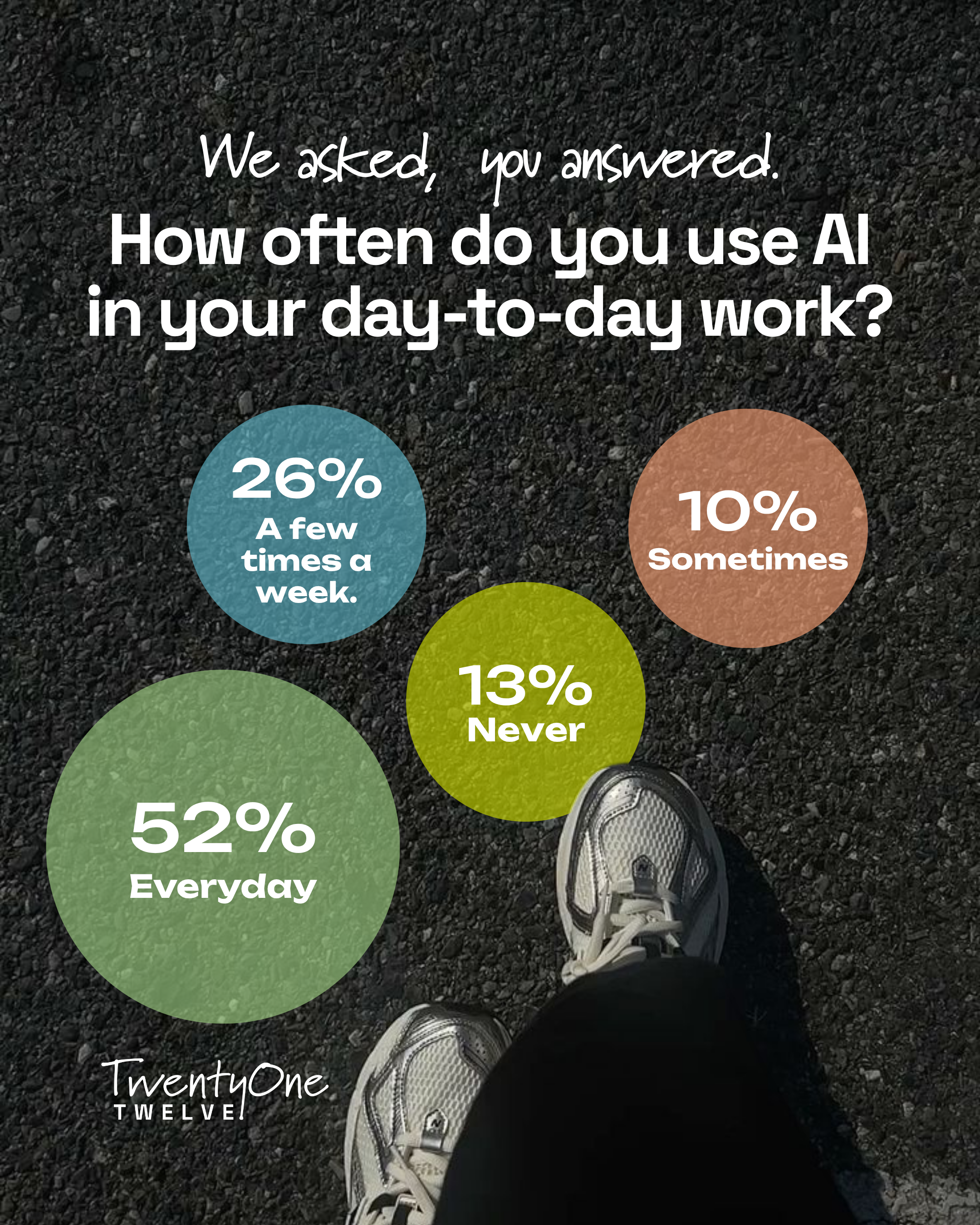
More than half of people said they use AI every day (52%), and another quarter reach for it a few times a week. Only a small handful said they never touch it.
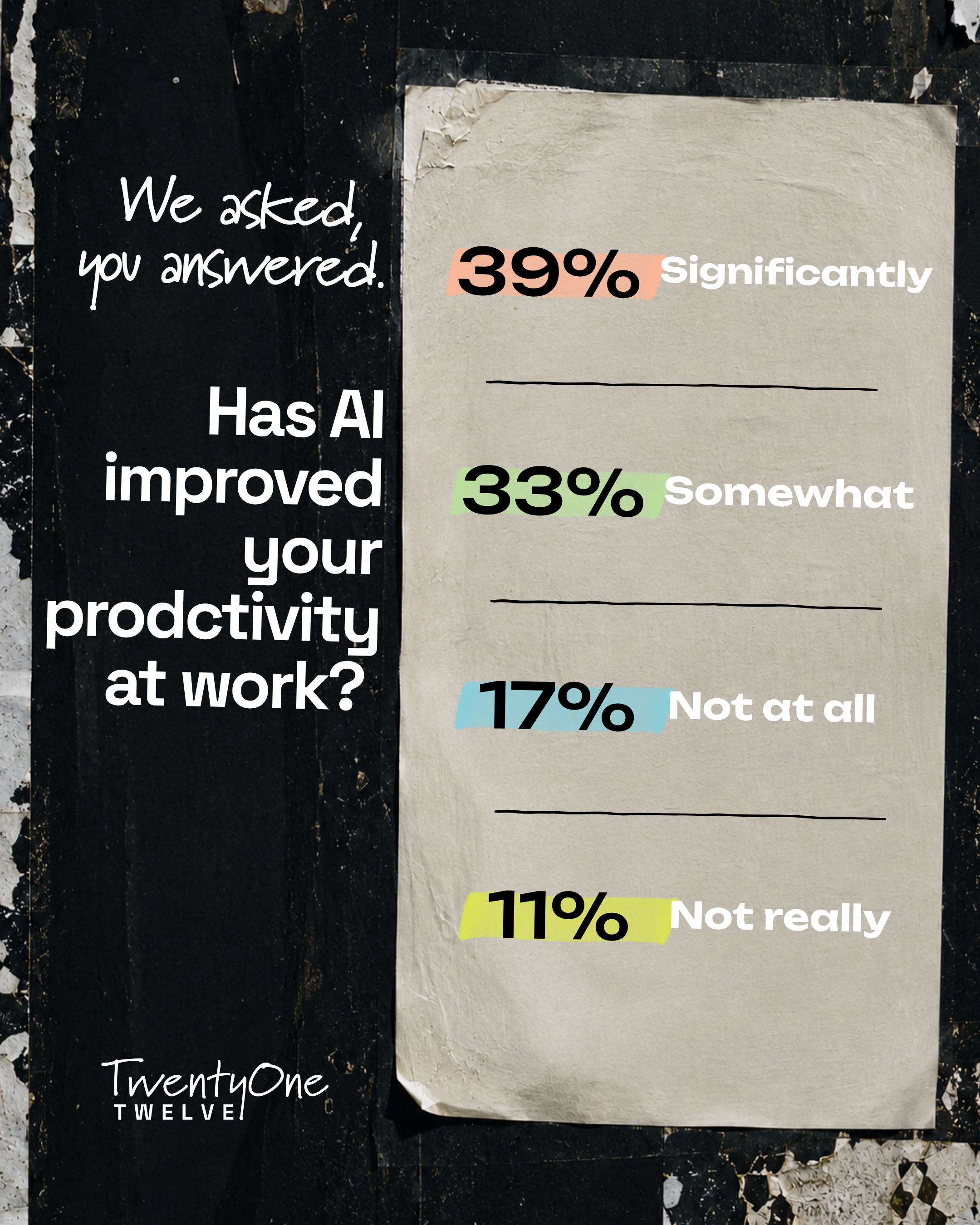
When we asked whether AI had improved their productivity, almost three quarters said yes. Thirty-three percent said significantly, thirty-nine percent said somewhat. In the space of a couple of years, AI has quietly become another tool in the working day, sitting alongside the inbox and the calendar.
So far, so expected.
What people are worried about has changed
The most interesting answer wasn't about how much people use AI. It was about what's on their mind when they do.
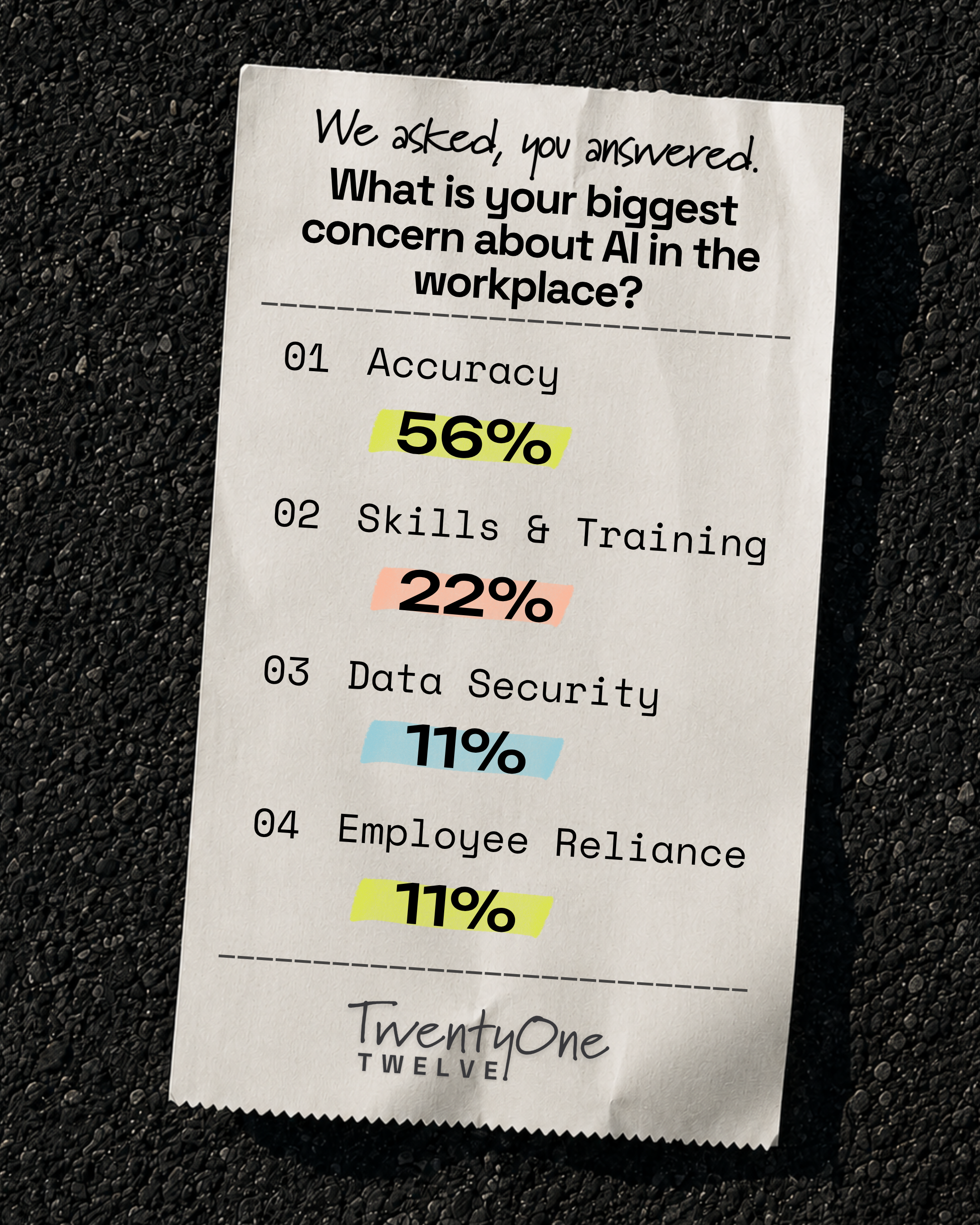
When we asked about their biggest concern, accuracy came out on top by a distance. Fifty-six percent named it, well ahead of skills and training (22%), data security (11%), and over-reliance (11%).
To me, that says something bigger about where the conversation has landed.
A year ago, the question was whether AI would take people's jobs. Now it's whether we can trust what it gives us. That's a healthier place to be. It means people have stopped treating AI as a threat and started treating it as a tool, one that needs checking, judgement, and a person keeping an eye on it.
We're seeing the same shift in recruitment
Very few clients come to us asking for "AI experts". What they actually want is people who can use AI to work smarter, while still bringing creativity, critical thinking, and sound judgement to the table.
The tool is easy to learn. Knowing when to trust it, and when to push back, is the harder and more valuable skill.
Most businesses are still finding their feet
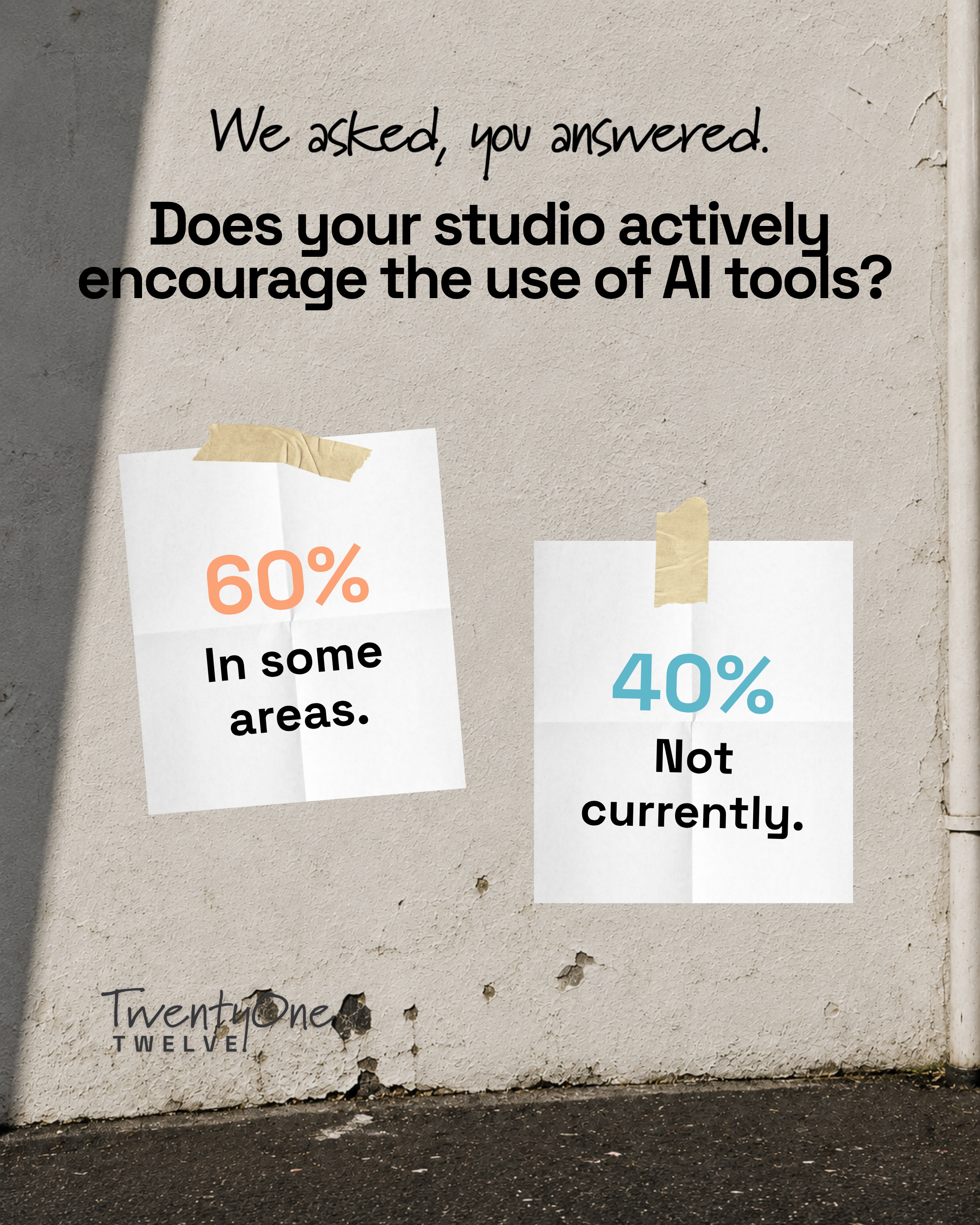
One answer summed up the moment nicely. Sixty percent of people said their organisation encourages AI in some areas, but not a single person said it was fully embedded across the business.
That feels about right. Most companies can see the opportunity. They're still working out how to take it responsibly, without cutting corners on quality or trust.
For me, that's exactly where the opportunity sits.
The people who'll stand out aren't the ones using AI the most
They'll be the ones who know when to use it, when to leave it alone, and how to pair it with the things technology still can't do.
AI can make you faster. But curiosity, empathy, original thinking, and strong relationships are still what make the real difference. I don't see those becoming less valuable. If anything, they're becoming the whole point.
Creative Industry Trends 2025: What's Shaping London's Design Market.
The UK's creative sector has grown 9% since 2020, far outpacing the broader economy. London hosts nearly 30% of design jobs, and demand for creative talent is only accelerating. Here's what's shaping the industry in 2025 and what it means for your career or your next hire.
The UK’s creative industry is booming, driven by exciting digital innovations and a surge in demand. From virtual reality to AI-powered design, companies are looking for skilled creative talent to lead the way and deliver standout work that captures the imagination of clients and consumers.
Since February 2020, the UK’s creative sector has grown by an impressive 9% - far outpacing the broader economy’s 1.6% growth. It's an incredibly exciting time to ride this creative wave, whether you're a creative professional, a business owner, or a specialist in design recruitment!
Let’s dive into some key stats and trends that highlight where the buzz is strongest and what it means for jobs.
Rising Demand for Creative Professionals
The UK’s design economy is booming, and nowhere is this growth more evident than in London. From Architecture and Interior Design to Graphic and Digital Design, the demand for creative professionals is soaring. Between 2010 and 2019, the design economy grew at twice the rate of the UK economy, and all signs point to this momentum accelerating in 2025.
Our 2024 Market Review and Salary Report highlights rising hiring and salary trends across key fields like Interior Design, Digital Design, Architecture, and Client Services. London, the epicentre of the UK’s design economy, hosts nearly 30% of design jobs and a third of all design businesses. As Deloitte forecasts 4.3 million creative jobs by 2030, there’s no better time to be part of this vibrant and rapidly expanding sector. If you’re looking for opportunities in design, London is calling!
Growing Competition for Creative Talent
When you’re looking to hire someone for a design, digital or creative strategy role, you’re likely to find competition for good talent is rather tough. And the fact is, it’s not going to get easier in 2025. Whilst there is strong revenue growth evident for creative economy businesses, profitability is getting squeezed by increases in salaries and pay rates, as companies race to snap up skilled talent.
The challenge for employers is to demonstrate why their business is a great place to work – by articulating their employee value proposition (EVP). Companies with strong EVPs will cover the essentials of attracting talent, like a competitive base salary. But it’s just as important to emphasise other factors that make your company an attractive place to work. Flexible work arrangements, for example, have become increasingly valued by candidates in recent years – and we see no sign of that desire abating!
Creative professionals are also flocking to roles that offer autonomy and opportunities to work on inspiring projects and innovations. The most sought-after candidates want to work for companies that provide genuine career development and invest in their people for mutual growth. With that said, as an employer, you can differentiate by offering clear career growth paths and support for upskilling.
Investing in training and development may become increasingly essential rather than optional for employers in the creative industries, as there are warning signs of a dwindling pool of fresh graduate talent. The number of students taking Design and Technology (D&T) at GCSE has halved over the last decade, indicating that fewer young people are gaining foundational skills in creative disciplines.
AI Everywhere?
Generative artificial intelligence is by far the biggest headline story in several industries, particularly creative fields like design and digital. From graphic design, and 2D design to video and coding, AI has upped the ante for creative work. Now, the challenge is to see who can do the most interesting stuff with it!
Can we expect AI to replace many design jobs? Whilst it’s too early to make that call, we’ve seen numerous examples of gen AI lifting productivity for designers in multiple disciplines. Considering that the rate of AI adoption has at least doubled over the past five years, demand for designers shows no signs of slowing down.
In 2025, we could expect human skills and talent to come at an even higher premium, as AI use becomes increasingly mainstream. Professionals with a strong grounding in design disciplines will be highly sought after for their ability to combine creativity with strategic thinking.
Sensory Experiences
In 2025, we may firmly find ourselves in the realm of the senses, at least when it comes to design innovations. More interior design and architecture projects will involve creating multi-sensory spaces that blend digital and physical experiences. As Dentsu highlights, there’s a growing demand for immersive sensory activations, where elements like touch, sound, light, scent, and gesture converge to captivate audiences.
Engaging senses all five senses requires design and creative professionals with a multi-disciplinary mindset, who can meld the digital with the experiential.
Industries such as hospitality, retail, and cultural institutions are hunting for new ways to engage consumers with a multi-sensorial feast of sound, colour, light, touch and scent. From hotels incorporating haptic feedback into guest rooms to museums designing exhibits with interactive light and sound, the emphasis is on creating environments that stimulate and inspire – and look amazing on social !
Nostalgia Vibes
From the aesthetics of nostalgia (90’s fashion revival, music on vinyl, vintage cameras) to the growing desire to disconnect from digital technologies (at least once in a while), nostalgia will be a powerful force for creative professionals and consumers alike in 2025.
For built environment professionals (interior designers, architects), nostalgia will inspire the creation of spaces that evoke the vibes and memories of a bygone era – whether it be brutalism or mid-century modernism.
On the digital front, graphic designers will draw on forgotten visuals like the pixelated, DIY look of early MySpace pages or the grainy, low-res charm of flip phone photography. By remixing these tiny slices of history, brands can be sure to capture attention with a playful feel.
The Rising Tide for Creative Recruiters
With creative sectors set for a bumper year in 2025, people with a background in recruitment for creative sectors are going to see their boats lifted by the same tide.
As the creative sectors continue to expand, recruiters with experience in or passion for these industries will be instrumental. After all, creative businesses need help in identifying the talent that brings these trends to life. If that sounds like your kind of thing, we’d love to chat with you about our internal opportunities. Please feel free to send us a message to introduce yourself and pop your CV over to us!
Connect with the Creative Recruitment Specialists
Ready to add a team member or two, or planning your next career move for 2025? Twenty One Twelve’s creative and design recruitment specialists can help you get sorted with a solution or role that’s right for you.
Contact us today for support in growing your team or finding your next role. We’d love to chat with you!