What Are We Really Optimising For?
For years, the conversation around flexible working has centred on one question.
How much flexibility do people want?
Our August polls suggest we've largely answered it. And the answer is more interesting than it first appears.
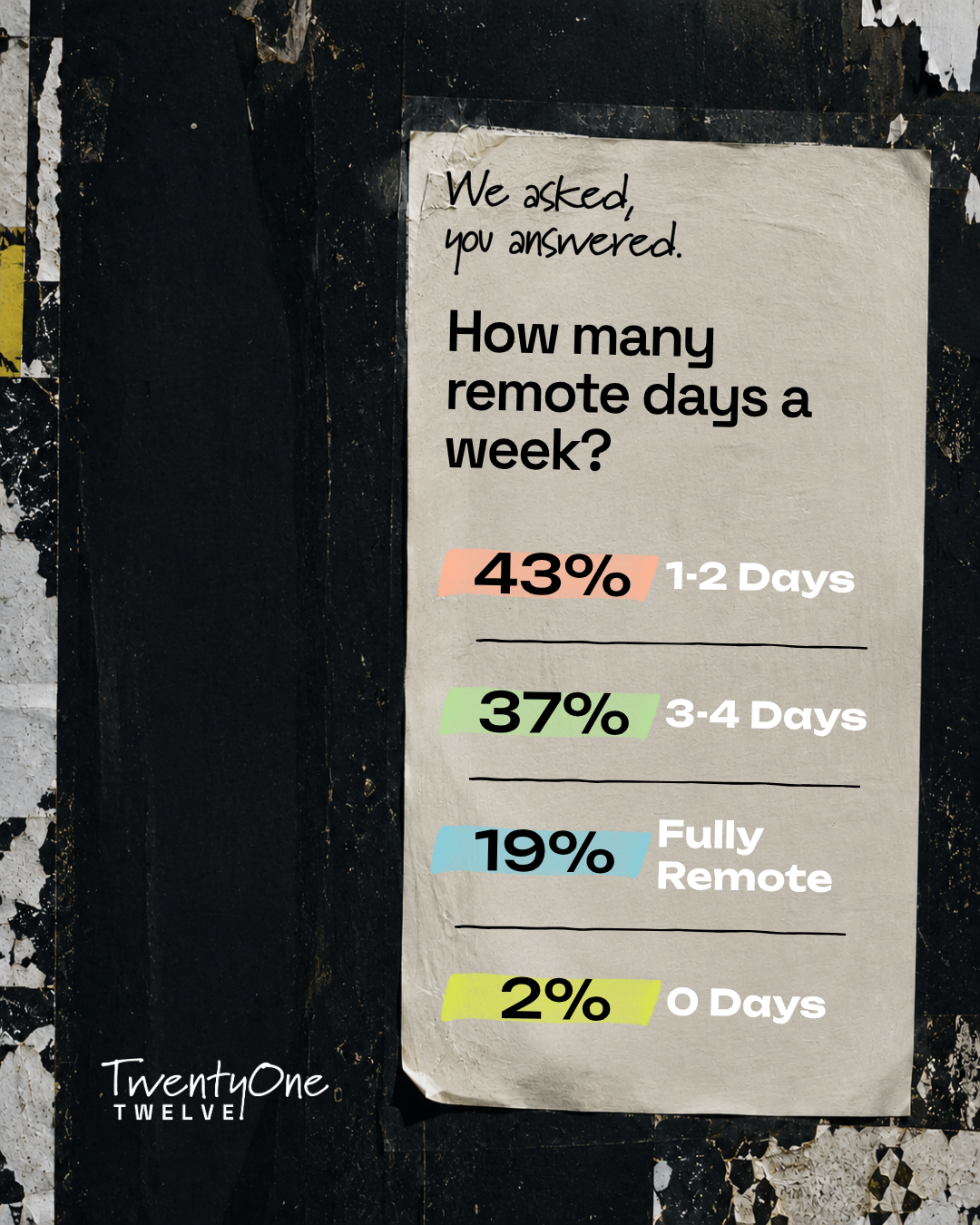
Only 2% of respondents wanted to be in the studio five days a week. Only 19% wanted to work fully remotely. The overwhelming majority wanted something in the middle, tilted slightly toward the studio. So the argument was never really office versus remote. It turns out it was always about one day.
But the more revealing question was the one about salary.
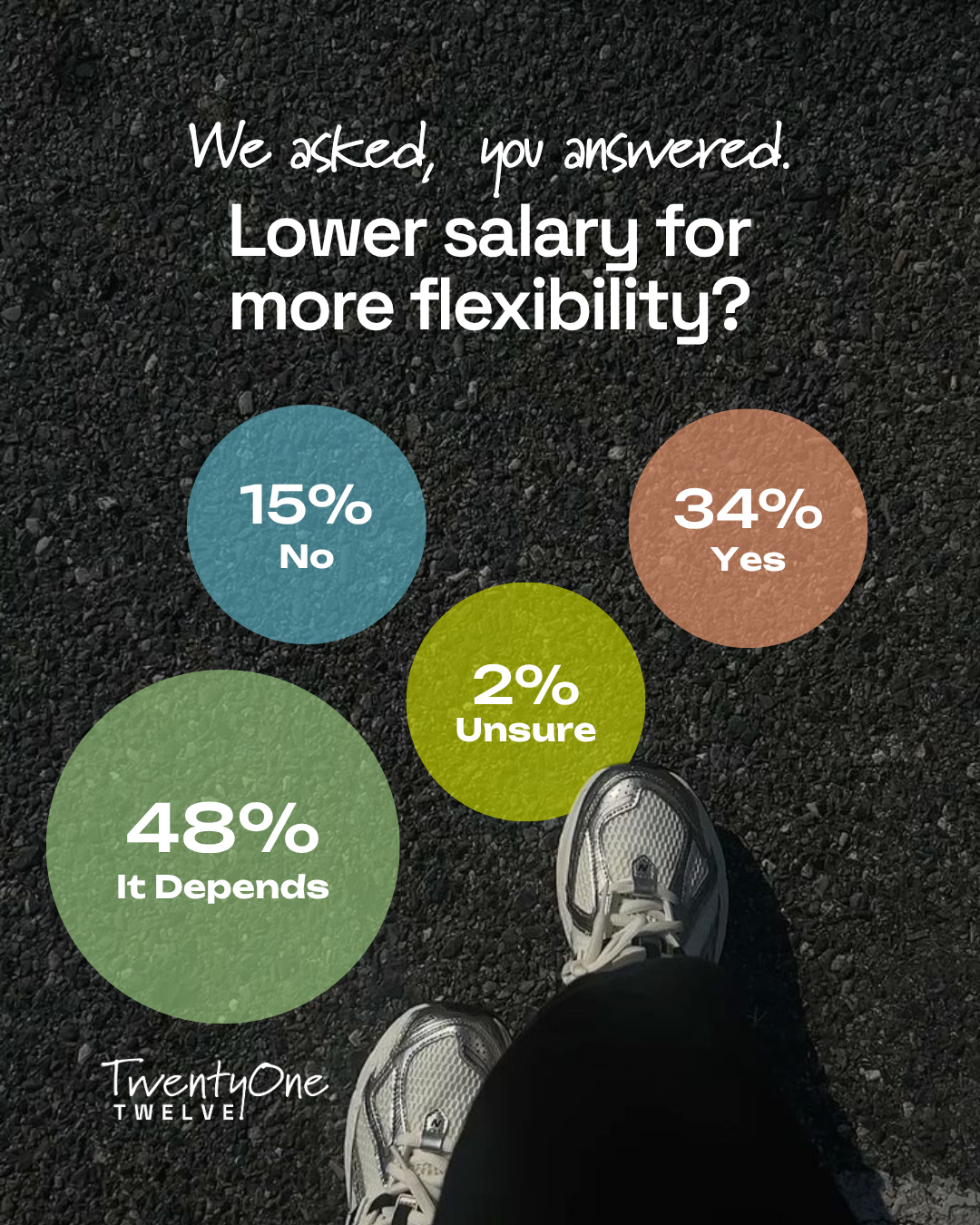
We asked whether people would accept a lower salary in return for greater flexibility. Only 15% said a flat no. A third said yes outright. The biggest group, nearly half of all respondents, said it depends.
Flexibility isn't a principle people hold. It's a price they negotiate. And almost everyone has already done that calculation in their head long before they walk into an interview.
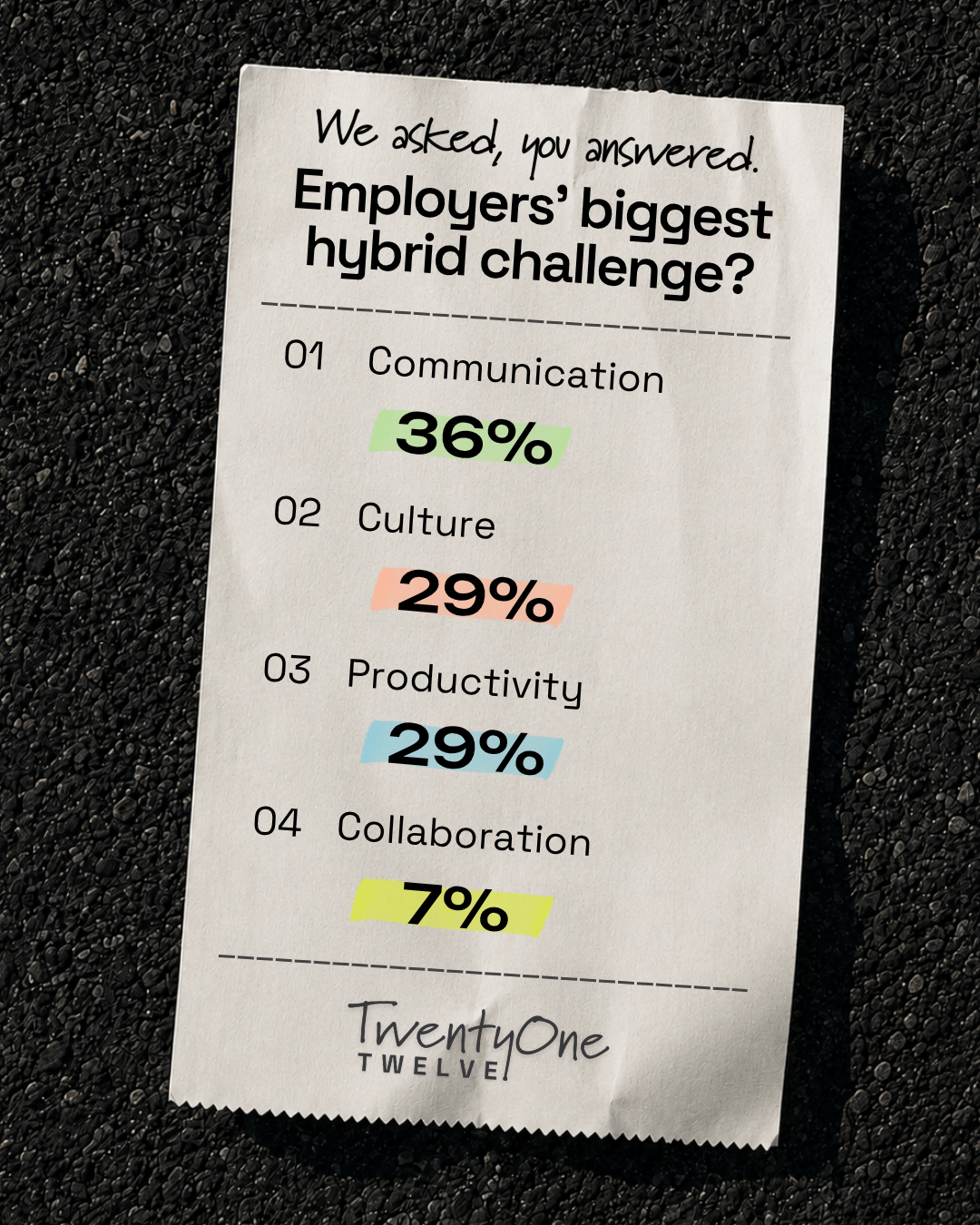
When we asked employers about their biggest challenges with hybrid working, productivity wasn't the standout concern. Communication came first, then culture. Together they accounted for nearly two thirds of responses.
That's worth pausing on.
I was speaking recently to a senior freelance creative who'd worked across several studios in the past few years. In one, a project alignment meeting took fifteen or twenty minutes. Everyone was in the room, decisions were made, the team moved on. In another, the same outcome across a hybrid team regularly took close to two hours. Several times a week. Nobody was doing anything wrong. It just took longer, to coordinate, to align, to recreate the conversations that happen naturally when people are in the same space.
Nobody was tracking that time. Nobody was adding it up.
That's not an isolated story. It's a version of something we hear regularly from studio leaders who find it genuinely difficult to say out loud, because saying it feels like the wrong side of an argument they're not sure they're allowed to have.
The talent market has made honesty feel risky. So the operational reality of running a hybrid studio often goes unspoken, while the conversation stays fixed on what people want rather than what any of it costs.
I've watched one studio move to a fully remote model after years of building a close-knit culture. Within months, something had shifted. The work was still being delivered. The revenue was holding. But the energy felt different. The relationships that had held the business together had quietly begun to weaken in ways that were hard to point at and harder to reverse.
And here's the detail that rarely makes it into this conversation. The studios most likely to lose their teams fastest aren't the ones with rigid office mandates. They're the ones that transitioned to fully remote after years of working another way. Studios that were built remote from the beginning, where everyone joined knowing exactly what they were signing up for, tend not to have this problem. The culture was designed around the model. But when a studio that built its identity, its relationships and its way of working in a shared space decides to go fully remote, something doesn't transfer. And the people who feel that most acutely are often the ones who leave first.
That's not an argument against remote working. It's an argument for knowing what you're changing when you change it.
There's another question that rarely surfaces in this debate, and it's the one that stays with me most.
Who does flexibility actually serve?
For someone fifteen years into their career, a few days working remotely is rarely a barrier to anything. They've already built their networks. They've developed their judgement. They know how to read a room, navigate a client, mentor someone coming up. The flexibility works for them because everything else is already in place.
But what about someone at the beginning?
How do you learn the things that aren't taught in a job description? How do you absorb the texture of a client conversation, the instinct behind a creative decision, the way a leader handles something going wrong, if you're not in the room when it happens? How do you build the kind of relationships that shape a career, across a camera, in a meeting that was scheduled because the spontaneous version no longer exists?
We talk a lot about developing the next generation of creative talent. We talk less about whether the environments we've built are actually capable of doing that.
Some of the most creative and commercially successful studios I know don't have fixed hybrid patterns. What they have is intention. A clear sense of what they're building and how the way people work either serves that or quietly undermines it.
And that intention matters more now than it ever has.
British creative businesses aren't competing against the studio down the road anymore. They're competing on a world stage, against markets with lower costs, faster turnaround and genuine technical capability. Price alone was never going to win that. It certainly isn't going to win it now, when surging costs have made our pricing less competitive than it once was.
What wins globally is the quality of thinking. The depth of collaboration. The kind of creative energy and innovation that comes from teams who are genuinely connected to each other and to the work. That's always been the competitive advantage of the best studios in this country. It's the thing clients on the other side of the world will pay for, when they can get it from somewhere cheaper and won't settle for less.
If that's what's quietly eroding, the stakes are considerably higher than a difficult meeting.
Every working model optimises for something. The studios that are getting this right aren't necessarily the ones that gave people exactly what they asked for. They're the ones who understood what they couldn't afford to lose, and made decisions accordingly.
The question studio leaders are sitting with, often privately, often without a vocabulary for it, isn't really about days in the office.
It's about what they're slowly losing, and whether the market will wait for them to notice.